
Factions and politics
Authority
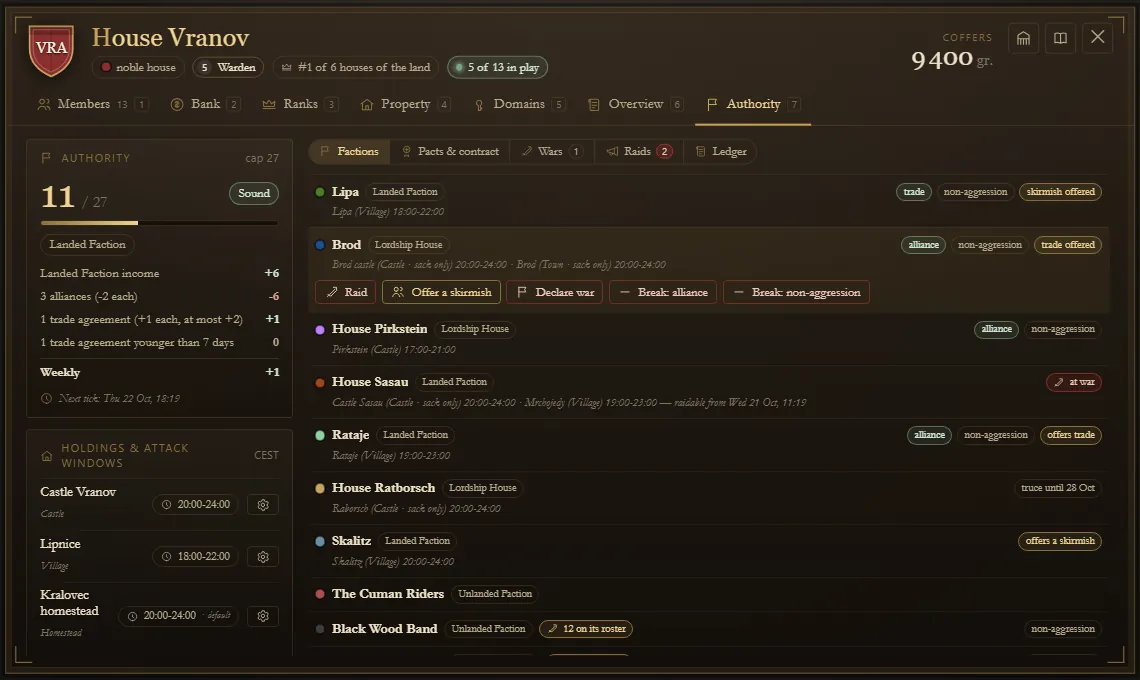
Authority is a faction's standing to make war and peace: a bank that fills every week and pays for raids, wars, battles, sieges and pacts. Only the side that starts a fight pays; defending is always free.
What Authority is
Every faction has an Authority bank, a whole number. It grows once a week, and the faction spends it to start hostile actions and to sign the costlier pacts. Before anything is done, every rule is checked and you get a plain answer: YES, with the cost and what your bank will be after it, or NO, with the reason and what you can do about it. Every window shows that check before you confirm, and every change to a bank, and every groschen paid, is written in the faction's ledger with the time, the amount, the reason and the new balance.
It is not the same thing as a faction's influence in each town, which keeps working as before.
Who acts for the faction
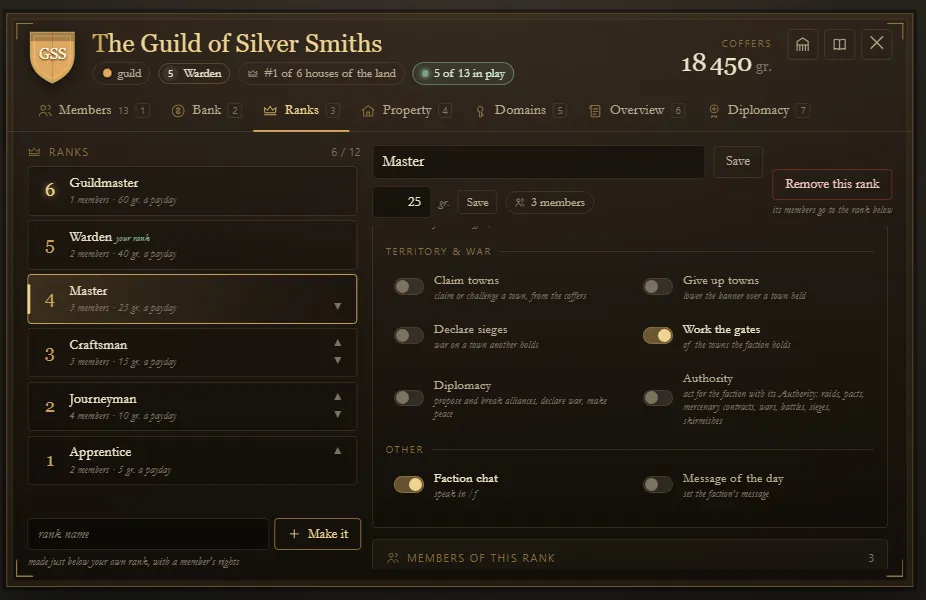
The faction's master, and every rank given the new Authority right on the Ranks tab. When a server takes up the system, every rank that held the old Diplomacy right gets it, the old alliances are brought over, and every faction starts with one week of its income in the bank (a faction founded later starts at 0).
Three kinds of faction
| Kind | Weekly income | Bank cap | What it means |
|---|---|---|---|
| Lordship House | +9 | 40 | A great House holding a lordship (a Lord among its members, or a lordship's castle town held). Set by Faction Management. |
| Landed Faction | +6 | 27 | Holds land: a town, a village, a castle or a homestead. |
| Unlanded Faction | +3 | 13 | Holds no land. It cannot be raided, may declare a raid from anywhere, and may sign non-aggression pacts and alliances, declare small wars and be hired as mercenaries - but it signs no trade agreement, hires no mercenaries, and calls or suffers no pitched battle or siege. |
The cap is 4.5 weeks of income: what the weekly amount would add above it is lost. A faction that loses its last holding becomes Unlanded at the next weekly count. Faction Management can also register a faction as a mercenary company: it keeps its own kind and income, and can be hired (below).
The weekly count
Once a week, on Monday at midnight, each faction receives its weekly amount: its income, -2 for each alliance, and +1 for each trade agreement at least 7 days old (at most +2 from trade in all). Wars that have run their 28 days end, the banks are cut to their caps, and every faction's leaders get a weekly statement.
| State | Bank | Weekly amount | What it means |
|---|---|---|---|
| Sound | 0 or more | 0 or more | Anything the bank can pay for. |
| Draining | 0 or more | below 0 | Allowed, but the bank shrinks every week. The tab shows how many weeks are left, and the leaders are warned when two or fewer remain. |
| In debt | below 0 | +1 or more | No spending at all until the bank is back to 0 or more. Free actions stay open. |
| Collapse | below 0 | 0 or less | Never allowed to last: the faction's newest alliance breaks at once and it pays a penalty of 3, again and again, until its weekly amount is +1 or better. The partner pays nothing. |
What it costs
| Action | Authority | Paid by |
|---|---|---|
| Raid | 3 | the raiders |
| Raid during a war between the two (wartime raid) | 2 | the raiders |
| Declare war | 12 | the attacker (refunded if Faction Management refuses the war) |
| Pitched battle | 6 | the side calling it (refunded if the other cedes the field) |
| Siege | 9 | the side calling it |
| Skirmish, waylaying, defending | free | - |
| Non-aggression pact | free to sign and keep; 4 to break | the breaker |
| Trade agreement | 4 each to sign, +1 a week each; 8 to break | both sign, the breaker pays |
| Alliance | 6 each to sign, -2 a week each; 12 to break | both sign, the breaker pays |
| Mercenary contract | no Authority: 500 groschen a head of the company's roster a day, 1 to 30 days, paid up front | the hirer's coffers |
Holdings and attack windows
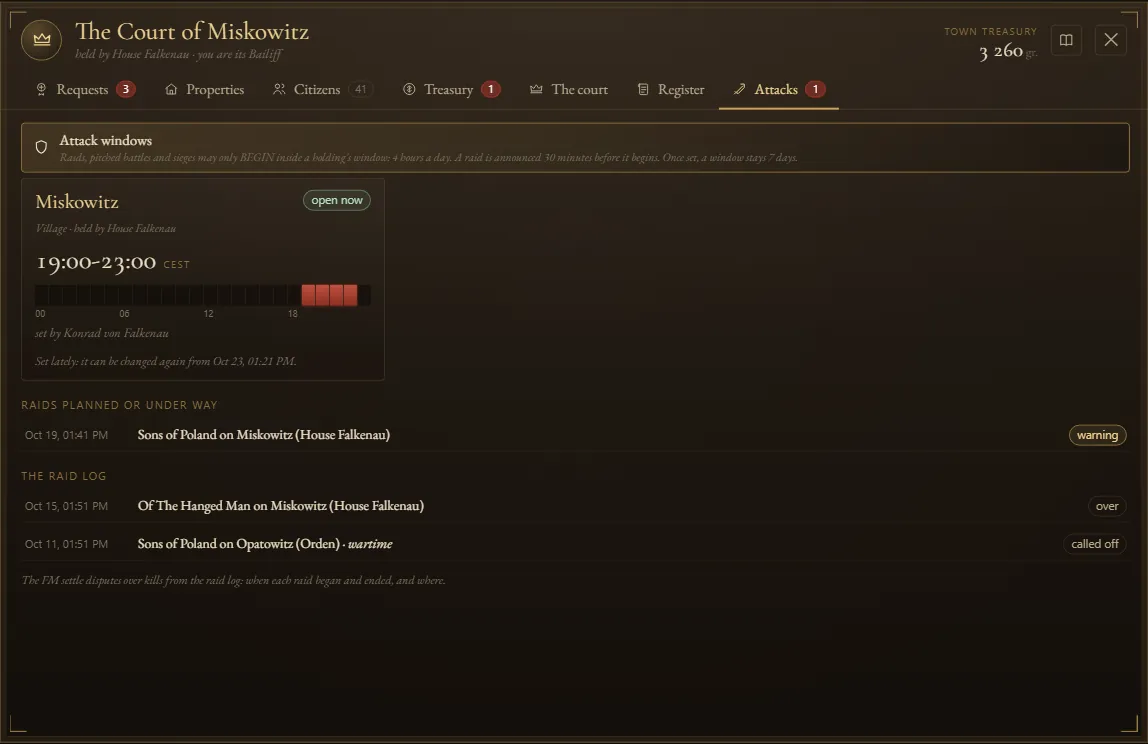
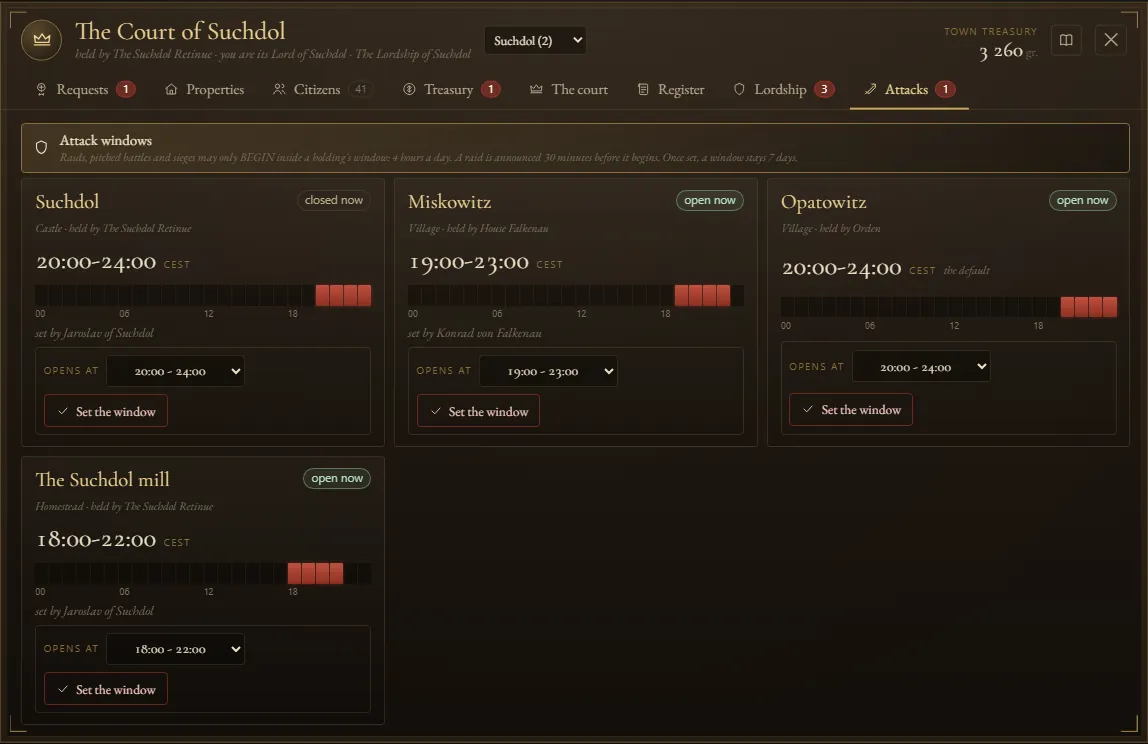
A faction's holdings are the towns and villages of the land it holds, and the castles, villages and homesteads Faction Management registers for it. Each holding is open to attack 4 hours a day: a raid, a pitched battle or a siege must begin inside its target's window. The default window is 20:00 to 24:00, Paris time. A town's window is set by its head or its Lord in the town court's Attacks tab (F2 > Town court, or /court); another holding's by the holding faction's leaders from the Authority tab, or with /attackwindow [holding] [hour]. Once changed, a window stays as it is for 7 days, so nobody dodges a raid by moving it every evening.
Raids
A raid falls on one holding of another, landed faction. There is no limit on how many take part, hired mercenaries included.
- Declare
A landed faction declares from inside one of its own holdings (an unlanded one from anywhere): the Authority tab's Raid, or
/raid <faction> [holding] [time]. Pick the hour it begins, inside the target's window and at most 24 hours ahead. Refused if the two factions have a non-aggression pact or a truce, or if any of the target faction's holdings was raided in the last 72 hours (48 for a wartime raid). The cost is paid at once, and the target's cooldown starts from the declaration. - The warning
30 minutes before it begins, the bell (or a horn where there is none) rings over the holding and the town clerk proclaims it to everyone inside. Every member of the target faction is told, wherever they are. A reminder comes 5 minutes before.
- The raid
From the start, anyone inside the holding may be slain - raiders, defenders and bystanders alike. Those inside wear [Raid] over their heads. The raided ground is no crime scene: no cry, no guards' hunt, no wanted notice, bounty or trial for a blow struck there. Horses may gallop in the town while it lasts.
- The end
After 60 minutes, or when the raiders withdraw (
/raid end), the all-clear sounds and the clerk says the raid is over. Its start and end are logged: Faction Management settles disputes over kills from them.
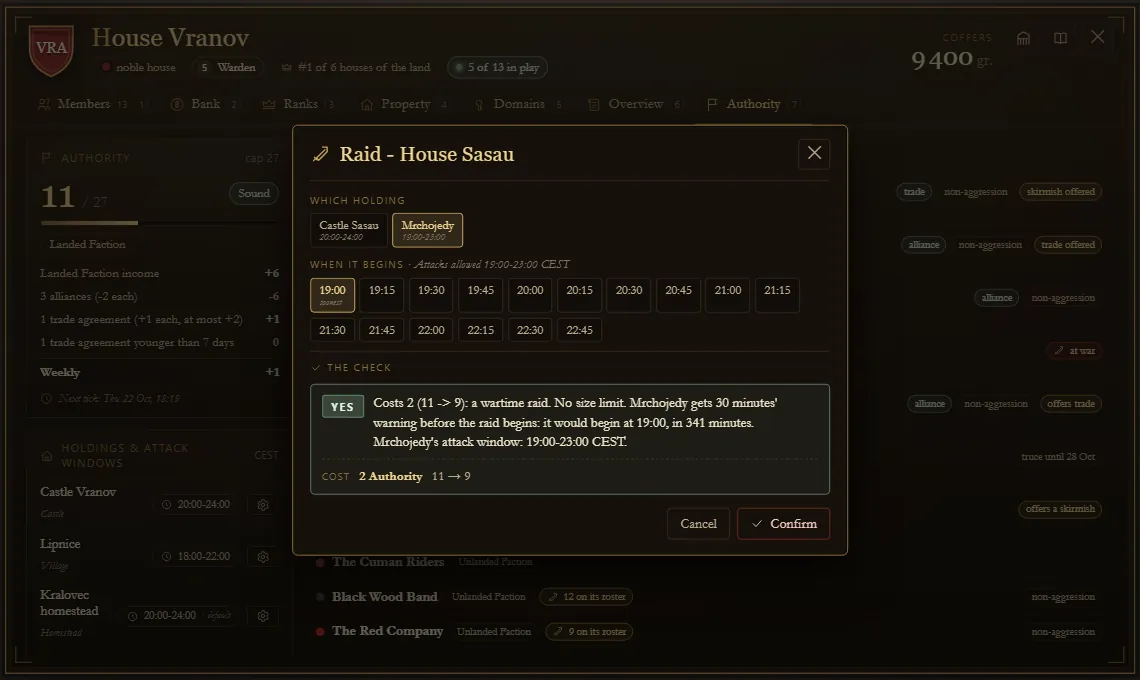
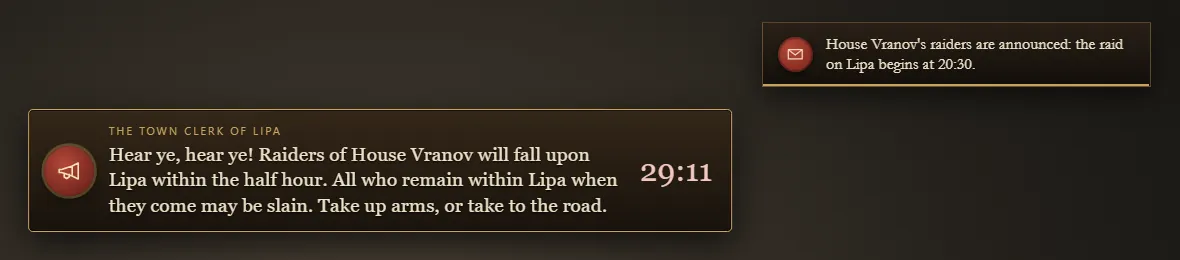
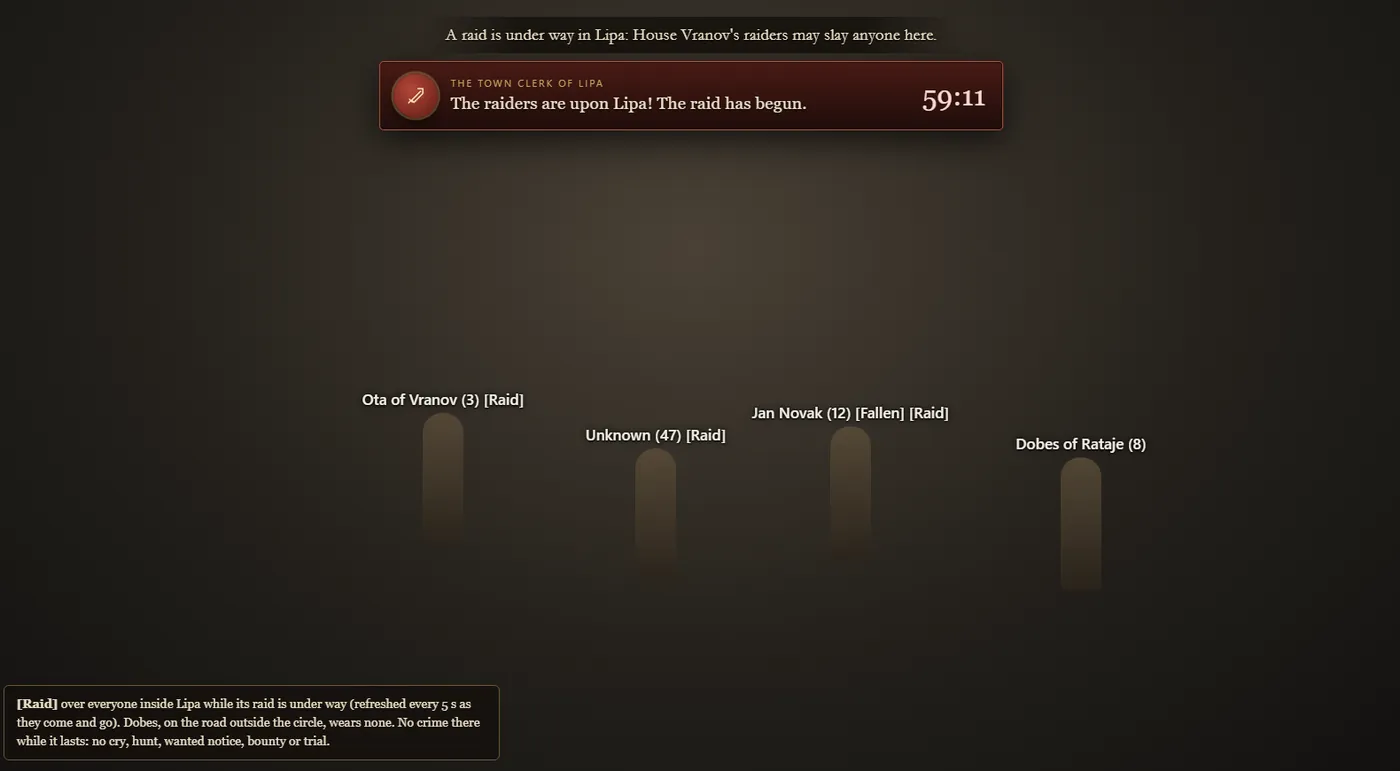
Winning a raid. When a raid ends (its 60 minutes run out, the raiders withdraw, or Faction Management ends it), the living inside the holding are counted: members of the raiding faction against members of the holding faction - in a wartime raid also the factions on each side of that war and the mercenaries either side hired. The dead and the downed count for no one, nor do bystanders. With strictly more raiders standing, the raid is won; otherwise the defenders held. A won raid takes 5% of the town's treasury (the town court's, rounded down) into the raiders' coffers - nothing from a holding with no town treasury. The outcome, the counts and the loot are announced at the end and kept in the raid log; Faction Management may rule a raid won or held afterwards (a won raid ruled held pays its loot back from the raiders' coffers).
Pacts
Two factions hold at most one pact of each kind with each other, and none while they are at war. Both sides must accept. A trade agreement, an alliance or a mercenary contract needs a non-aggression pact between the same two factions first.
| Pact | What it does |
|---|---|
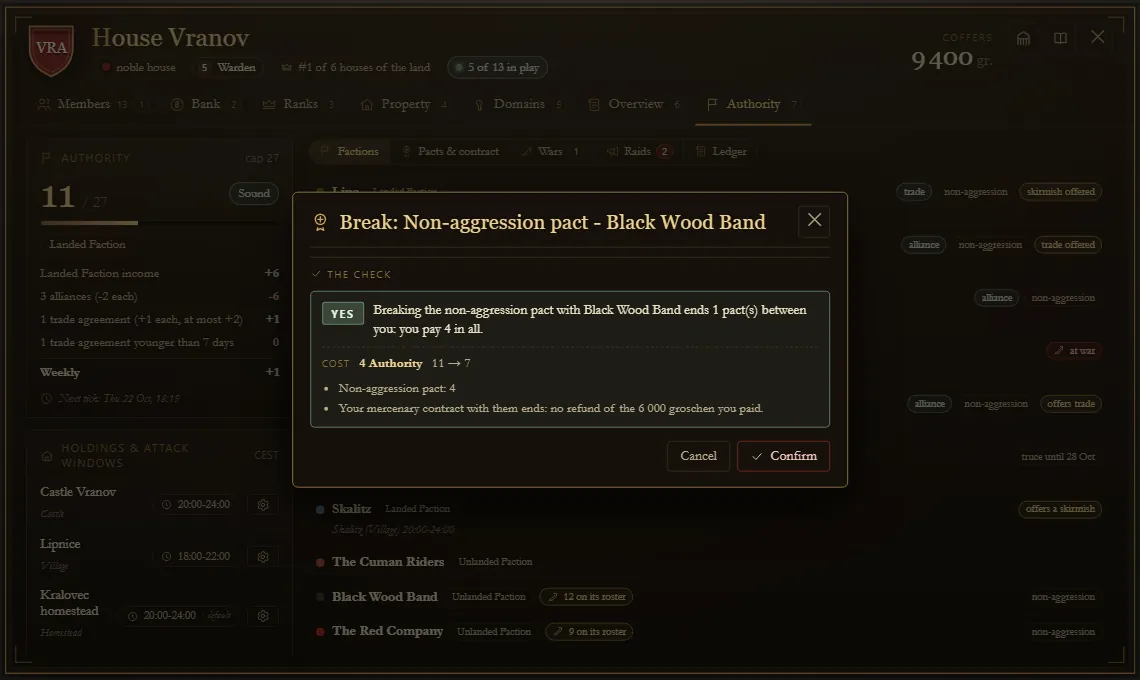
| Non-aggression | Neither side may raid the other or declare war on it. Free. Breaking it costs the breaker 4 - and ends every other pact between the two, the breaker paying each one's break fee too (non-aggression, trade and alliance: 4 + 8 + 12 = 24). The window lists every pact that would end and the total before you confirm. |
| Trade agreement | Between Lordship Houses and Landed Factions. +1 a week each from the first weekly count at least 7 days after signing, and the auction houses take 50% less of their cut on every sale between the two factions' members in either partner's houses. Broken on its own for 8; the non-aggression pact stays. |
| Alliance | Sealed in roleplay by one of the four bonds - a marriage, a ward or hostage, vassalage, or a pledge of land - which Faction Management confirms before it starts. Allies may join each other's wars (below). If signing would leave your weekly amount below 0, the check warns you how long your bank lasts. |
Mercenary contracts
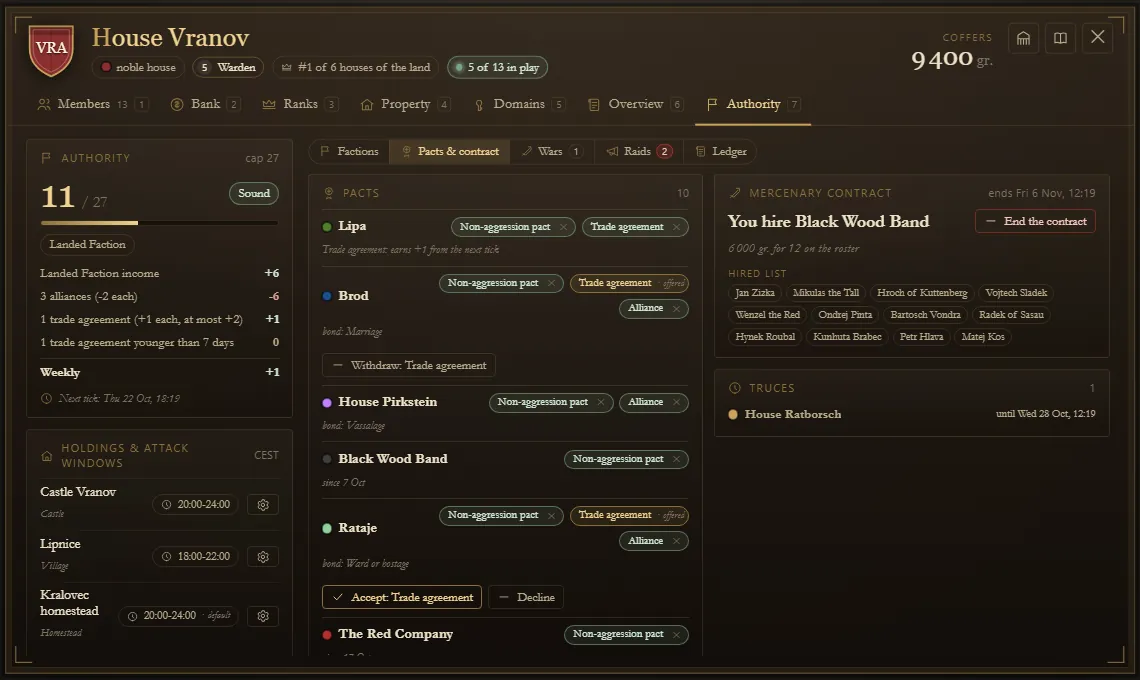
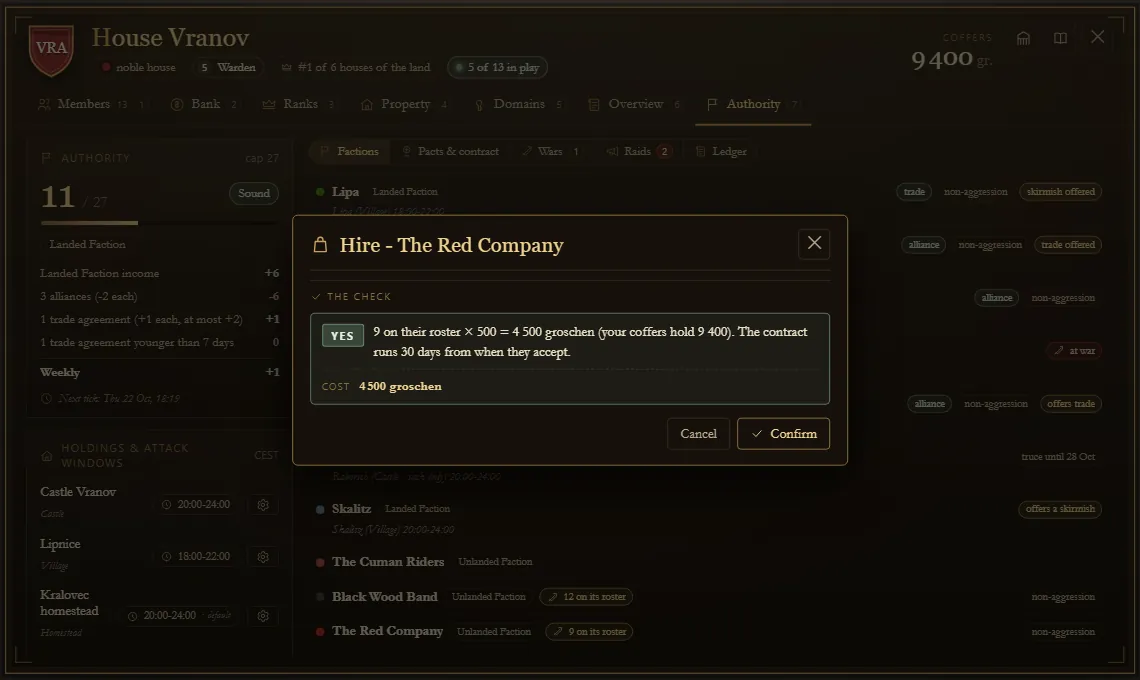
A Lordship House or a Landed Faction hires a registered mercenary company at 500 groschen a day for every member on its roster, for 1 to 30 days - the hirer chooses the length - and the whole price is paid up front, from the hirer's coffers into the company's (a roster of 10 for 7 days: 10 x 500 x 7 = 35,000 groschen). It costs no Authority, and influence debt does not stop it. The two need a non-aggression pact and may not be at war; a company serves one hirer at a time.
- Offer
The hirer uses
/hire <company> <days>(7 days if left out), or the tab's Hire with its days picker and the total shown before confirming: both sides see the price and the length. - Accept
The company uses
/hire accept <hirer>. If its roster changed since the offer, the offer lapses and the hirer makes a new one at the new price. Otherwise the coin moves, and the members on the roster become the hired list. - Serve
The hired members may join the hirer's raids, skirmishes, battles and sieges at once, even in the middle of a war (joining an attack only if the company has no pact or truce with the target). Members who join later are not covered; those who leave drop off. A hired mercenary slain in a raid, battle or siege of a war cannot fight again in that war.
- End
The contract ends the days chosen after signing, with a reminder 3 days before (halfway through a contract shorter than 6 days); to keep the company, sign a new one afterwards.
/contract endends it early: the hirer gets nothing back, while a company that walks out repays the full price.
Wars
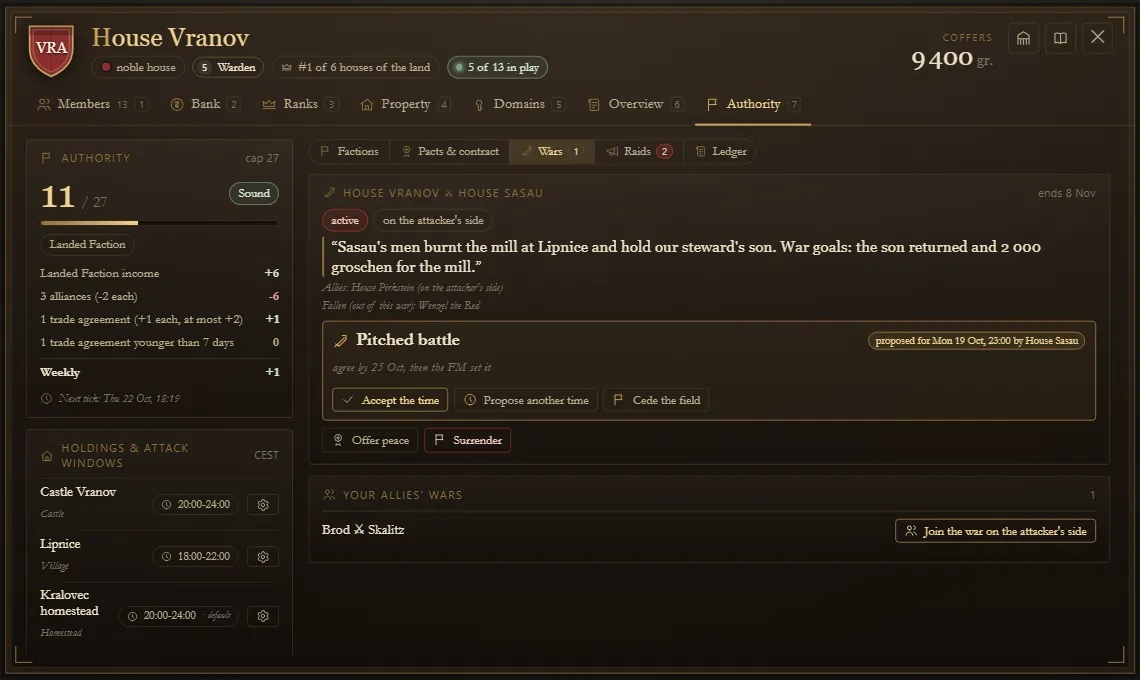
/war declare <faction> <goals>, with the casus belli and the war goals (or the tab's Declare war) costs 12. Not possible with a non-aggression pact (break it first), a truce, or a war already between the two, and a faction is the attacker in only 1 war at a time. The war waits for Faction Management, who read the casus belli: approved, it becomes active for at most 28 days; refused, the cost is refunded. If either side is unlanded, it is a small war: raids and roleplay only, no pitched battle or siege. A war ends when both sides offer peace (/peace <faction>), one surrenders (/peace <faction> surrender), Faction Management finds its goals met, or its time runs out. A truce of 14 days follows: no raid and no war between the two, though they may sign a non-aggression pact.
- Pitched battle
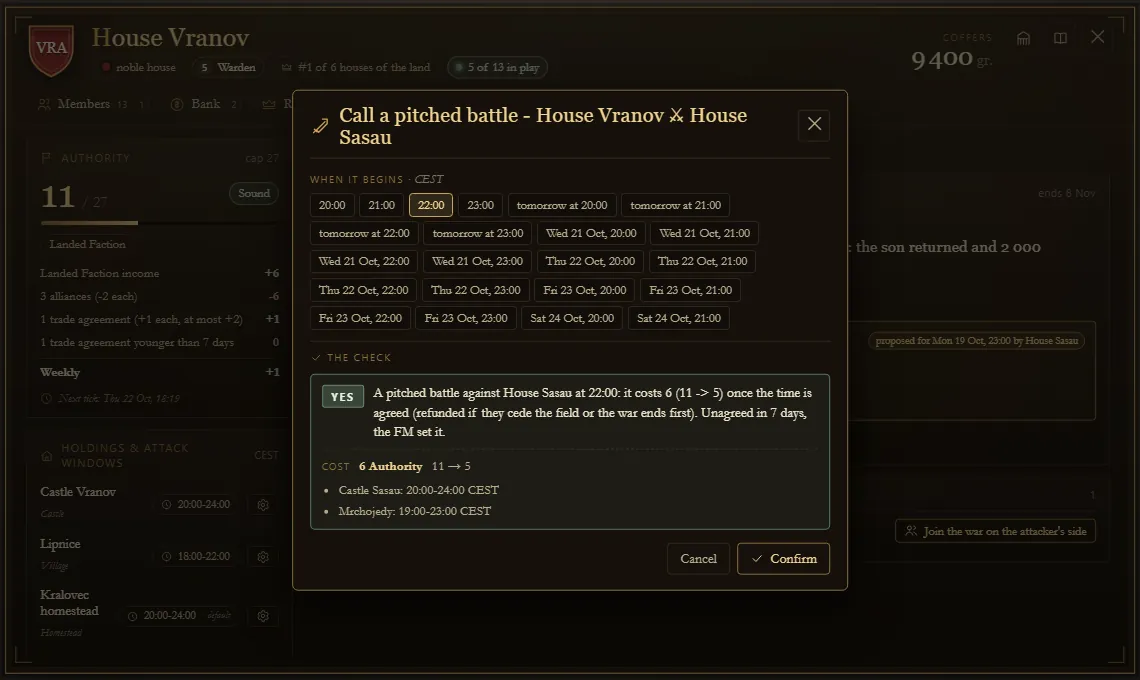
The attacker or the defender (never an ally) calls it for 6, both sides landed:
/battle <war> <time>. The time must fall inside the other side's window. The other side accepts it, proposes another (/time accept|counter), or cedes the field (/cede <war>: the caller is refunded and holds the field). Not agreed within 7 days, Faction Management sets it. The cost is paid when the time is fixed, and refunded if the war ends first. Faction Management records the winner, who holds the field. - Siege
Only the side holding the field may call one, for 9:
/siege <war> <time> [holding]. Booking it clears the field: a second siege needs another battle. If the attackers win they choose to occupy the holding (it passes to them for good) or to sack it (they leave, taking half of the defender's coffers). A lordship's town can only be sacked, never occupied. A faction that loses its last holding becomes unlanded. - Allies
A faction allied to one side for at least 7 days before the war was declared may join it for free (
/join <war> <attacker|defender>). Joining the attackers needs no pact or truce with the defender; joining the defence needs nothing. Allies fight in battles and sieges but do not call them.
Skirmishes
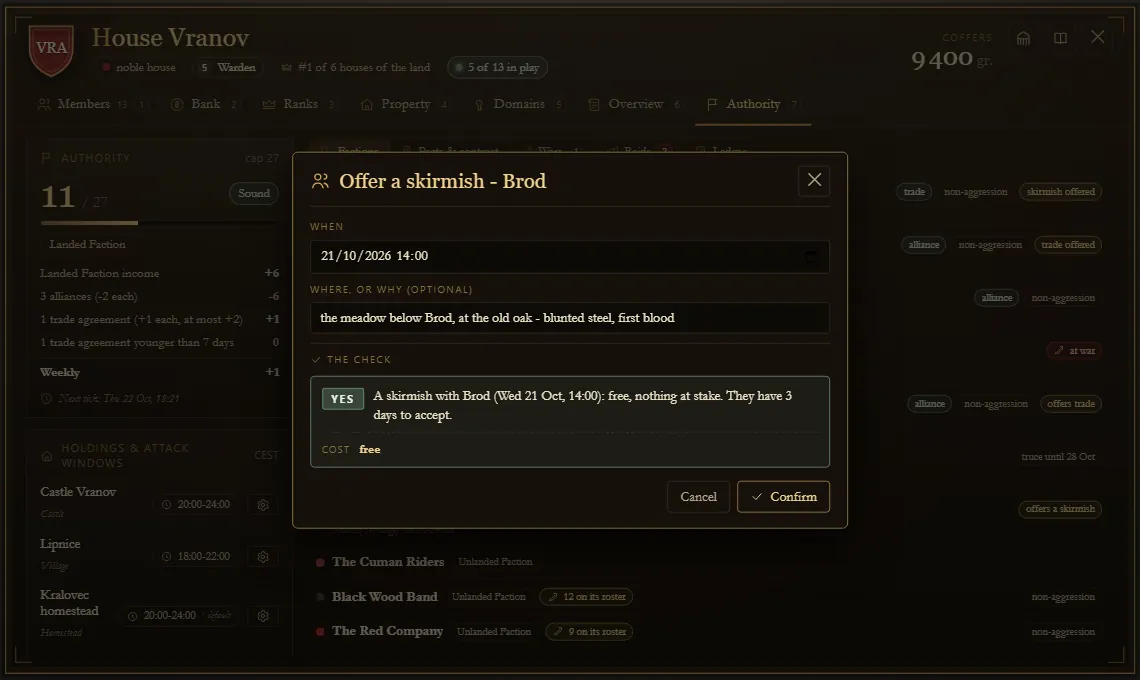
An agreed clash with nothing at stake: free, and both sides must agree. /skirmish <faction> [time] [where or why] offers it; the other side has 3 days to /skirmish accept or decline, and the offerer may withdraw it. An agreed skirmish is written in both factions' ledgers, and horses may gallop in a town while it is fought there.
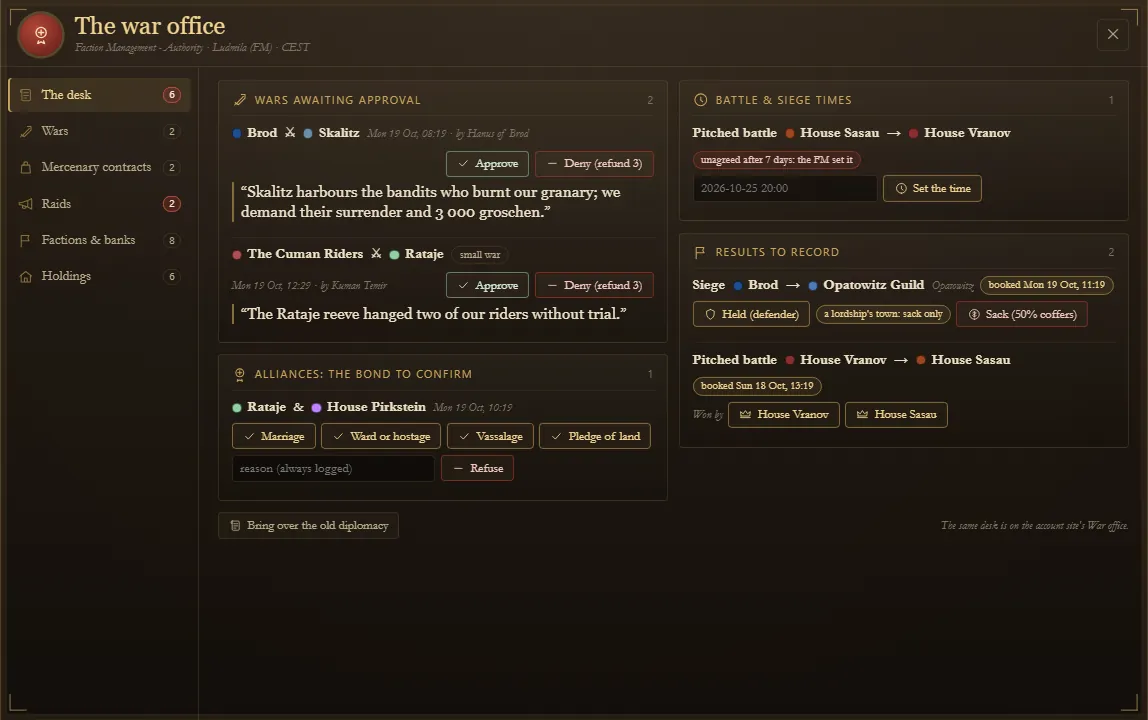
Faction Management's war office
Faction Management approve or refuse wars, confirm alliance bonds, register mercenary companies, set battle and siege times the sides could not agree, record winners and siege results, record a mercenary's death, end or void a raid, void a contract, adjust a bank with a reason and register holdings - in game and on the account site's War office. Every declaration, raid and approval is posted to their log.
The commands
| Command | What it does |
|---|---|
/authority | Your faction's bank and cap, the weekly amount line by line, its state, pacts, contract, wars, truces, and when your land can next be raided. |
/raid <faction> [holding] [time] | Declare a raid. /raid window <faction> shows when it may begin; /raid cancel calls it off during the warning; /raid end withdraws once it has begun. |
/pact offer|accept|decline|withdraw|break <faction> <nap|trade|alliance> | Offer, answer or break a pact. |
/hire <company> [days], /hire accept <faction> | Offer a mercenary contract of 1 to 30 days (7 if left out), or accept one. |
/contract, /contract end | Your contract: the other side, the price, the hired list and the end date; or end it early. |
/war declare <faction> <casus belli> | Declare war (Faction Management approve it). |
/battle <war> <time>, /siege <war> <time> | Call a pitched battle or a siege. |
/time accept <war>, /time counter <war> <time> | Answer a proposed battle or siege time. |
/cede <war> | Cede the field instead of fighting the battle. |
/peace <faction> [surrender] | Offer peace, or surrender. |
/join <war> <attacker|defender> | Join a war as an ally. |
/skirmish <faction> [time] [where] | Offer a skirmish, or accept, decline or withdraw one. |
/attackwindow [holding] [hour] | Show your holdings' attack windows, or set one. |